Paper · samoan passage
Energy and Momentum of a Density-Driven Overflow in the Samoan Passage
Journal of Physical Oceanography 53(6)
Abstract
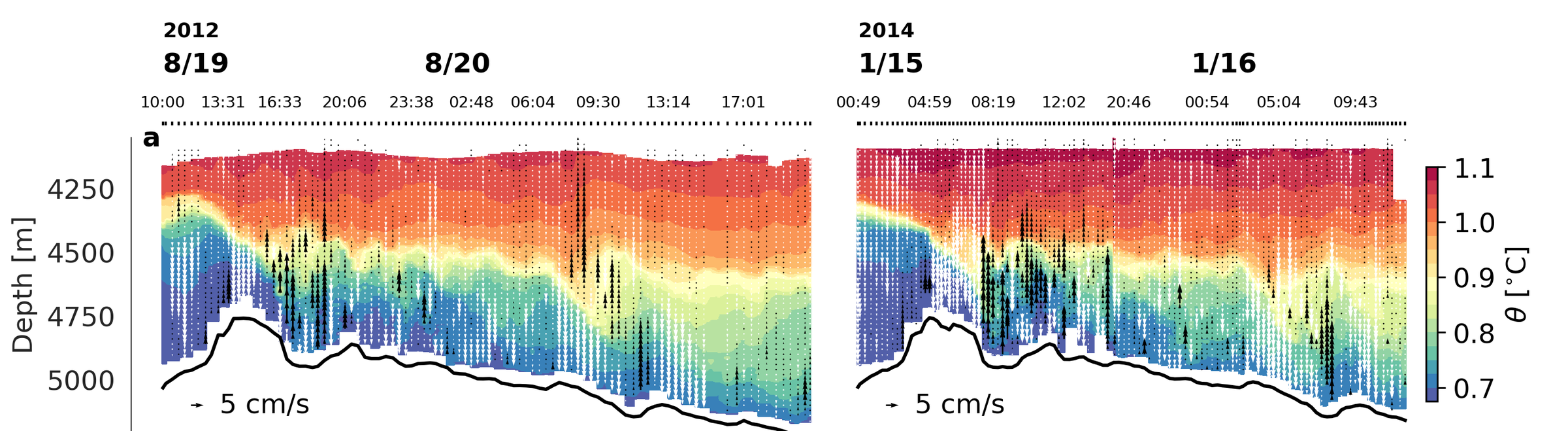
The energy and momentum balance of an abyssal overflow across a major sill in the Samoan Passage is estimated from two highly resolved towed sections, set 16 months apart, and results from a two-dimensional numerical simulation. Driven by the density anomaly across the sill, the flow is relatively steady. The system gains energy from divergence of horizontal pressure work (5) kW m-1
and flux of available potential energy (2) kW m-1
. Approximately half of these gains are transferred into kinetic energy while the other half is lost to turbulent dissipation, bottom drag, and divergence in vertical pressure work. Small-scale internal waves emanating downstream of the sill within the overflow layer radiate kW m-1
upwards but dissipate most of their energy within the dense overflow layer and at its upper interface. The strongly sheared and highly stratified upper interface acts as a critical layer inhibiting any appreciable upward radiation of energy via topographically generated lee waves. Form drag of (2) N m-2
, estimated from the pressure drop across the sill, is consistent with energy lost to dissipation and internal wave fluxes. The topographic drag removes momentum from the mean flow, slowing it down and feeding a counter current aloft. The processes discussed in this study combine to convert about one third of the energy released from the cross-sill density difference into turbulent mixing within the overflow and at its upper interface. The observed and modeled vertical momentum flux divergence sustains gradients in shear and stratification, thereby maintaining an efficient route for abyssal water mass transformation downstream of this Samoan Passage sill.
Project
2017
Hydraulic Processes in the Samoan Passage
NSF-funded project to study hydraulic processes in the abyssal flow through the Samoan Passage
Project 2012Samoan Passage Abyssal Mixing Experiment
NSF-funded project to study volume transport and mixing processes in the abyssal flow through the Samoan Passage