On the Nordic Overturning Circulation
Doctoral thesis on the mid-depth circulation of the Nordic Seas, the dense overflows across the Greenland-Scotland Ridge, and the entrainment that dilutes them downstream.
Warm Atlantic water flows north across the Greenland-Scotland Ridge into the Nordic Seas, is cooled and made dense there, and returns south as dense overflows through the deep gaps in the same ridge. South of the ridge the overflow plumes descend the continental slope and entrain the warmer, lighter water around them. That entrainment doubles their volume transport and accounts for about 30% of the dense water that eventually leaves the subpolar North Atlantic at depth. My doctoral thesis, written with Detlef Quadfasel at the University of Hamburg and accepted in 2010, worked on three links in this circuit: the interior circulation that is important for the water mass transformation within the Nordic Seas, the overflows themselves, and the entrainment downstream of the ridge.
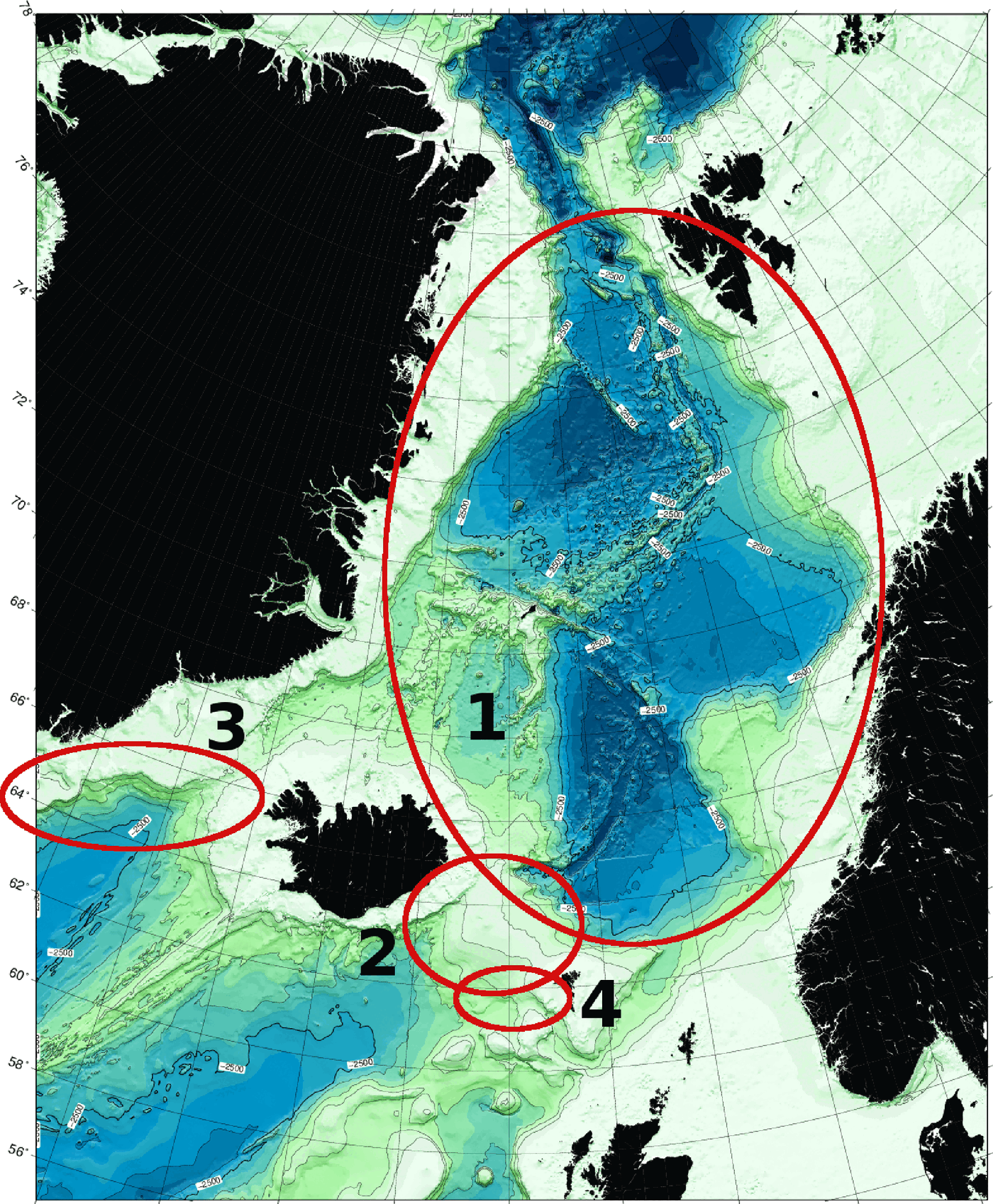
The first study used the trajectories of 61 Argo floats that drifted at mid-depth in the Nordic Seas between 2001 and 2009 to map the regional circulation. The flow follows the bottom topography closely, and it is cyclonic both on the basin scale and around the Nordic Seas as a whole, weak in the interior of the basins (less than 1 cm/s) and stronger at their rims (up to 5 cm/s). Very few floats crossed from one basin into another, so the recirculation within each basin dominates the exchange between them. The seasonal variability of the gyres in the Greenland and Norwegian Basins follows the wind, and a barotropic vorticity balance forced by wind stress and bottom friction reproduces it. Over the Lofoten Basin and the Iceland Plateau the same balance explains less than half the variance. The work was published as The mid-depth circulation of the Nordic Seas derived from profiling float observations.
A second study asked how much dense water crosses the shallow Iceland-Faroe Ridge. Its width makes it the most demanding of the overflow passages to measure, and little is known about its variability on any time scale. Applying hydraulic control theory to historical hydrographic data gives a transport of 1 ± 0.6 Sv, half of it through the western valley at the Icelandic continental slope and half through the gaps further east. An independent estimate for the western valley from a two-year mooring record gives 0.5 ± 0.3 Sv. The two numbers agree, which supports the idea that the overflows across the shallow parts of the ridge are hydraulically controlled. This chapter remained an unpublished manuscript.
The two remaining studies dealt with entrainment. Moored current and temperature records combined with historical hydrography show the Denmark Strait overflow plume warming at 0.4 to 0.5 K per 100 km within the first 200 km of the sill, dropping to 0.05 to 0.1 K per 100 km beyond that. Lateral heat fluxes from stirring by mesoscale eddies account for 0.1 K per 100 km, so close to the sill something else has to contribute, most likely vertical fluxes driven by breaking internal waves. The study appeared as Entrainment in the Denmark Strait overflow plume by meso-scale eddies.
Direct turbulence measurements in the Faroe Bank Channel overflow found intense mixing and enhanced turbulent dissipation at the upper interface of the plume between the sill and 120 km downstream. The results have been published in a very nice GRL paper led by Ilker Fer. Read together with the Denmark Strait result and with earlier work, the two studies point to two entrainment regimes: strong vertical mixing near the sill while the plume is fast, and lateral stirring by mesoscale eddies taking over further downstream.
The full thesis is available as a PDF.