Drivers of Oceanic Change in the Amundsen Sea - DECADES
Measuring how warm Circumpolar Deep Water crosses the Antarctic shelf break and is transformed by turbulence on its way toward Pine Island Glacier.
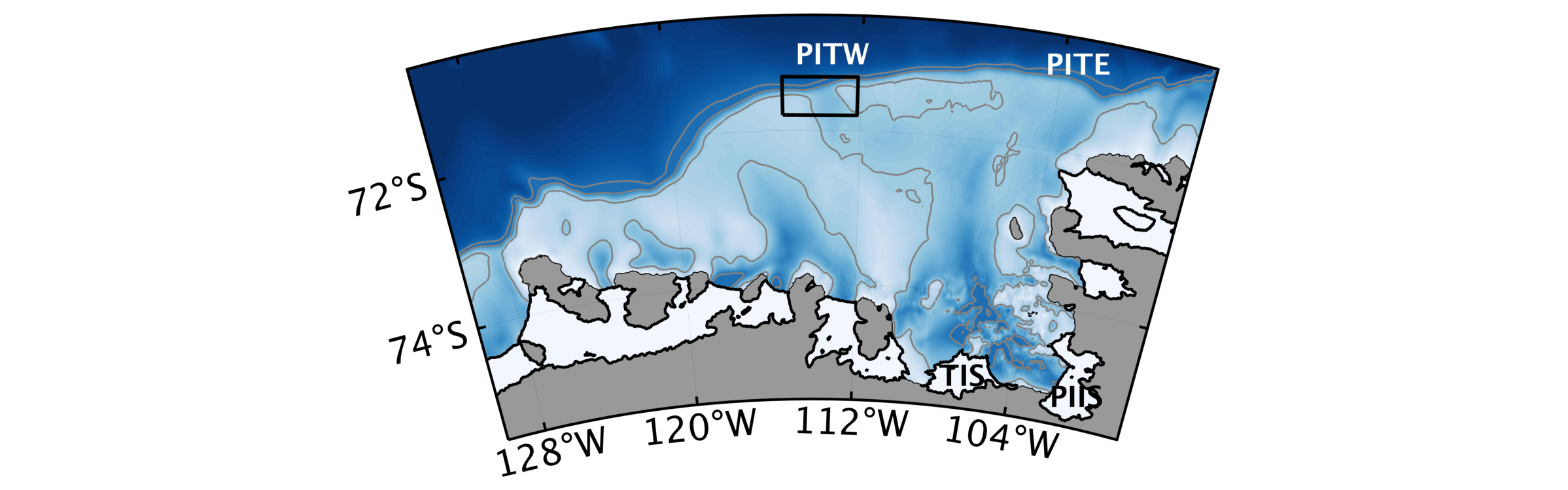
Since satellite radar altimeters began monitoring the surface elevation of the Antarctic Ice Sheet in 1992, the Pine Island and Thwaites glaciers have been losing mass and contributing to sea level rise. Much of that loss is driven from below. Warm Circumpolar Deep Water (CDW) crosses the shelf break of the Amundsen Sea and flows landward along troughs incised into the continental shelf, reaching the cavities beneath the floating ice shelves where it melts them from underneath. Moorings and satellite data show that the warm water arrives in episodes, and that those episodes have become more frequent as the wind patterns over the Amundsen Sea have shifted.
How the current makes its way onto the shelf, which depths it occupies, and how much heat it finally delivers to the ice are still open questions. So is what happens to the water along the way. Turbulent mixing at the shelf break stirs CDW into the colder water above and below it, and this mixing sets the temperature of the water that continues toward the glacier. Almost no turbulence measurements exist at the trough entrances where the transformation is expected to be concentrated.
DECADES, short for Drivers of Oceanic Change in the Amundsen Sea, is a project funded by the UK’s Natural Environment Research Council and led by Adrian Jenkins. It is built around two research cruises with the British Antarctic Survey to the Pine Island Glacier region, deploying moorings and seal tags and carrying out shipboard observations at the Pine Island Thwaites West Trough, one of the troughs where CDW is known to enter the shelf.
Our part of the project, funded by the National Science Foundation, adds high-resolution profiling to this field campaign. From the ship we will run FastCTD and Epsifish sections in a radiator pattern around the northwest corner of the trough entrance, which gives near-synoptic views of density, velocity, and turbulent dissipation across the inflow. We will also deploy three McLane Moored Profilers, vehicles that travel autonomously up and down a mooring wire carrying a CTD and an ADCP. Two of them, one at the shelf break and one inside the trough, will profile for the full year between the two cruises and resolve the seasonal cycle of the inflow at much finer vertical resolution than the fixed instruments on the surrounding moorings. The third carries an Epsilometer for direct turbulence measurements and stays in the water only for the duration of the first cruise.
The project is led by Nicole Couto, together with Matthew Alford and Gunnar Voet, all at Scripps. Fieldwork was originally planned for the austral summers of 2024 and 2025. Scheduling delays have pushed the first cruise to February 2027, aboard the RRS Sir David Attenborough.